Dr. Robert Falconer-Taylor BVetMed, DipCABT, MRCVS.
Robert has worked in the veterinary profession for nearly 30 years, as a partner in an innovative small animal hospital group and as a locum. Alongside his role in day-to-day clinical medicine, Robert has also been very much involved in the management, communication, and education side of veterinary practice. During this time, he was directly involved in the conception and implementation of computerisation into the profession. This included a cross-fertilisation with the human healthcare system in the UK and the development of cross-platform coding and classification systems for disease identification, tracking and surveillance. This is now an integral part of the World Health Organisation’s One Health initiative.
Robert was also veterinary director and head of education of the Centre of Applied Pet Ethology (COAPE), the first organisation in the UK to develop government-regulated courses to degree level specifically in companion animal behaviour and training. COAPE also developed the renowned EMRA system used by behaviourists and trainers all over the world, now summarised in their book – EMRA Intelligence: The revolutionary new approach to treating behaviour problems in dogs.
He teaches and consults around the world along with writing for the veterinary and other professional press. He is also author of the informative PET CPD Blog, published on this website, which has been taken up and endorsed by many training and behaviour organisations all over the world. Robert is currently working on a book and on the development of a range of accessible online education resources for the companion animal community.
He is an international consultant to the pet industry where he has engaged in the development and risk assessment of pet ‘toys’ targeted specifically at promoting the welfare of pets and their relationships with their owners. He was also actively involved in the development of the ‘The Puppy Plan’, first launched in February 2012 and updated in 2014, a collaboration between Dogs Trust and the Kennel Club.
His current primary academic interests include companion animal cognitive science and emotionality, nutrition and its effects on behaviour, and applied neurophysiology, pharmacology, and therapeutics in companion animal behaviour therapy.
He promotes the idea wherever and whenever he can that – the key to better animal welfare is through education.
In Part 1 of this article, we took a look at exactly what cigarette smoke is and why it is so dangerous.
In this part, Part 2, we take a look at a random selection of a few of the thousands of studies published on the effects of smoking in humans, and especially children in SECTION B. There is less known about the negative effects of second-hand smoke on pets, but in SECTION C, we summarise the results of most of the studies that have been done in dogs and cats.
“Tobacco is the only legal drug that kills many of its users when used exactly as intended by manufacturers.”
This is the chilling opening sentence of the World Health Organisation’s global report on trends in tobacco smoking 2000-2025 (WHO, 2015).
Image by nikosapelaths [CC0 1.0]
The trouble is, many of these tobacco users are the dogs and cats living with us. This is wrong and it must stop. This is what this article is about. Please read it and then use it to help us end this now. We can do this if we work together. THANK YOU…
Gastric dilatation-volvulus (GDV), in the dog-world commonly called bloat, remains an enduring concern for all owners of at-risk breeds. Despite numerous studies on this horrible disease, a definitive cause has yet to be identified. This has left owners of susceptible breeds with a ‘shopping list’ of potential causal factors along with recommendations of how to avoid them, for example avoiding feeding from a raised food bowl.
When I started out in veterinary practice, I had the opportunity to care for army dogs and horses at the local army barracks. The best thing about it was that there were never any surprises. The animals I had to see were always lined up and ready when I arrived, and the dogs in particular were temperamentally very similar, rather like their human handlers I guess. This is why I like studies using military dogs. It eliminates much of the inevitable variability between pet dogs, their owners and their environments. This allows the collection of less cluttered and cleaner data sets. A potential disadvantage, of course is that the dogs may all be the same breed and sometimes from the same, potentially small, genetic pool. This could mean that the results of the study may not reliably reflect what one would expect to find in the general dog population.
But, I argue that studies looking at the maternal care of puppies are always interesting, especially when the results can be compared with other similar studies.
We live in an amazingly connected world where information propagates into every nook and cranny across the globe in an instant, something we could never have imagined just a couple of decades ago.
We Stand United – NYC Rally on Night Before Trump’s Inauguration. By mathiaswasik
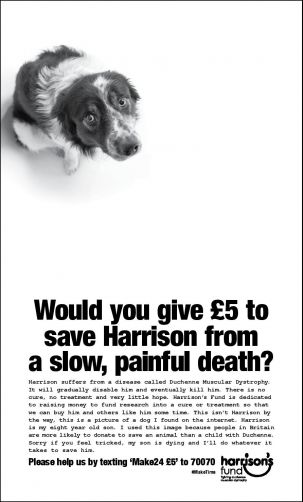
These are the words of a Father trying to save the life of his Son, Harrison. It is the title of the story about a controversial advertisement that appeared in the press in 2015 (Harrison’s Fund. 2015). You will need to visit the Harrison’ fund website to read the full story around this advert, CLICK HERE, and make a donation while you’re there.
Recently, I reviewed a new study on critical and sensitive periods in puppies (Morrow et al., 2015) HERE and came to the conclusion that is was an important addition and update to Scott and Fuller’s seminal work done in the 1960’s.
This is a difficult and a very personal blog for me to write. It’s been on my agenda for 7 years, but it has just been too painful to actually sit down and do it – until now.